Thursday, December 31, 2020
98: Time I Am
96: Reflections on Austerity
Creative Expression: Sharing realizations spontaneously
Bhagavad-gita, Chapter 16, Texts 1-3
Tuesday, December 29, 2020
91: Happiness - Nectar -> Poison
Wednesday, December 23, 2020
85: The Rising Sun of Faith
Creative Expression: Personal Narrative
When I was 12 years old, I developed a chronic and painful physical condition.
Three years later at the age of 15, I Googled symptoms. I saw that there was a high chance that my condition was cancer. (Note to self: never Google symptoms.)
Six months to a year to live.
My mind went numb. At fifteen, I had planned to travel to literally every single country in the world, establish schools, produce albums, write books, etc. etc. But when I read this potential death sentence, all of those plans imploded in my brain.
I walked around in a daze for weeks. Food tasted like sawdust. I didn't talk to anyone - I didn't want the pity of friends, the worry of my parents, the skepticism or interrogation or healing suggestions from adults.
What I wanted was solace. I wanted peace. I wanted to know my purpose in this short life, where I would go when I died, and if I would even go anywhere.
Who was I?
On our bookshelf at home sat this large book, which had been given as a gift:
Regardless of this being a "children's book," all the illuminations are taken directly from The Bhagavad-gita As It Is, translations by Bhaktivedanta Swami. One would think scripture is reserved only for scholars or adults, but this book defied that notion.
One day, I read this illumination:
These words rung within my being as the truest words I had ever heard in my entire life. My body filled with the solace and peace I had been yearning for. I remember sitting there and gazing at this illumination, gazing at Krishna's beautiful face, the ornate lettering, the drawings. I felt illuminated from within.
At the time of my greatest need, I felt as though someone had reached out to hold me in warm, gentle hands.
My physical condition lasted for many painful years, and even with many doctors and tests, we never figured out what it was. One day, the symptoms began to fade and they never returned.
What has remained with me until this day, 18 years later, is the unshakeable faith that I am an eternal spirit soul. Whether I die tomorrow in a car accident, ten years from now from cancer, or fifty years from now from an old and broken body, my soul will go on. The souls of my loved ones will always go on. Our souls shall exist forever.
Now, there are 700 verses in this ancient scripture, and maybe I don't understand or have faith in them all.
But I have faith in this one. No one and nothing can take away my faith in this verse, not even death.
Like the sun that is rising over the horizon of the ocean that starts out just as a little dot of bright orange, as time goes on that dot becomes a slice, and the slice becomes a semicircle, and on and on until the sun is rising in brilliant rays that light up the world.
This is how I feel about my faith in only one verse of the Bhagavad-gita.
The light of faith from one verse has been lighting up the other verses in this text, lighting up other texts in the bhakti tradition, lighting up the words and teachings of spiritual teachers in my own tradition, lighting up the teachers and scriptures and traditions of other spiritual paths of the world, and ultimately
lighting up my own heart and mind to love and serve God and God's devotees.
Just one verse.
So I am grateful to my painful condition for coming into my life at such a young age. I am grateful for Google's morbid (and inaccurate!) diagnosis.
I am grateful for the book, Illuminations from the Bhagavad-gita, by Kim and Chris Murray, for granting me the most priceless diamond of my existence: faith in my eternal soul.
Saturday, December 12, 2020
79: Levels of Happiness
CHAPTER 18, TEXT 38: That happiness which is derived from contact of the senses with their objects and which appears like nectar at first but poison at the end is said to be of the nature of passion.
Goodness (sattva) | Passion (rajas) | Ignorance (tamas) | |
Beginning | poison | nectar | poison |
End | nectar | poison | poison |
Wednesday, December 9, 2020
77: Description, Not Condemnation
CHAPTER 18, TEXT 28: The worker who is always engaged in work against the injunctions of the scripture, who is materialistic, obstinate, cheating and expert in insulting others, and who is lazy, always morose and procrastinating is said to be a worker in the mode of ignorance.
There is something very, very fascinating about how Krishna phrases His words in this verse. Well, not only this verse but any verse that describes types of people within the modes of natures.
He does not instruct.
He does not condemn.
He simply describes.
Sure, the words "obstinate" and "lazy" sound judgmental, but Krishna is not judgmental or petty in that way. He is objectively describing the mental habits and behavior of a worker who is cocooned within the mode of ignorance.
To be honest? I find myself being described here. But I don't feel condemned by God. In fact, I feel understood.
I feel understood for my habits of working in a lazy and morose way and constantly procrastinating. Prabhupad writes, "[Workers in the mode of ignorance] procrastinate; anything which can be done in an hour they drag on for years." I had to laugh at this statement, because I find such truth here. I can pull up a list in my mind of projects or "to-do"s that could be completed literally within an hour, but they go on uncompleted, year after year.
When I read this verse of the Gita I feel as though I am looking into the mirror. I see more clearly that, ah yes, I am often a worker in the mode of ignorance.
So I'll start there, by simply saying that I resonate with this verse, and I do not feel condemned, but understood.
Consequently, and naturally, I feel this lacking within my heart, this sense that I want to not be in the mode of ignorance. I want to be described in a different way. I do.
My next point now has to deal with the world that I observe around me, especially on social media.
1) I've begun to notice how there seems to be a confusion about what should be done and what should not be done. Recently I've seen some women share about the deep pain and challenge of motherhood. And while I understand that that's a reality, still... it's a stage of life. Billions of women have endured motherhood for millennia, how come suddenly motherhood is so shocking? Granted, I am not a mother, and I sound like I am condemning women for complaining about the challenge. Still, this verse from the Gita mentions that one who is "always morose" implies someone who is working with a kind of dread, frustration, and resisting the reality of one's duty day after day. While moroseness and the pain and challenge of motherhood is natural, to hang out in that space for a prolonged period of time seems to be resisting one's duty and to be working in the mode of ignorance.
2) I am seeing a lack of gentility in communication, and a prevalence of cutting insults towards others. I see name-calling, such as "racist", "neo-Nazi", "Karen", "white supremacist", "Uncle Tom", "baby-killers", "snowflake", "wimp" and more. Name-calling is a kind of laziness, labeling others in a way that demeans and disrespects without much consideration. Prabhupad writes that "Such workers are not very gentle, and generally they are always cunning and expert in insulting others." In fact, this brashness and cutting personality is even glorified in modern media. Youtube videos of personalities who condemn and name-call others are wildly popular. The problem with this new kind of gossip and name-calling is that it's out of touch with humanity. If we were all to relate with each other personally, one-on-one, this kind of painful communication would hurt and maim others in a deep way.
3) I am also seeing a kind of obstinate way of dealing with authority, a kind of obnoxious "push back" against being told what to do, especially according to any kind of scriptural injunction (which this verse of the Gita mentions). Authority is rejected and generally seen as an oppressive force that should be questioned at all times. At no point should authority be accepted and respected in any kind of deep way. This obstinate nature and refusal to accept authority is a trademark of workers in the mode of ignorance.
This post started out by saying that Krishna does not condemn workers in the mode of ignorance. Sure, His language is strong, but he is simply describing the truth of workers in this mode, just as he describes workers in the modes of passion and goodness. Krishna does not even instruct us to work in the mode of goodness.
He leaves it up to us.
We read how these workers are described. We look in the mirror and nod when we resonate.
And we make our own choice: what kind of worker do I want to be?
Okay, okay, show me the description of the worker in the mode of goodness. Let's do this. Because... that's how I want to be described. I want to look in the mirror and see that person.
So here it is: https://vedabase.io/en/library/bg/18/26/
***
Full purport here: https://vedabase.io/en/library/bg/18/28/
Tuesday, December 8, 2020
76: Bodily Discomfort
CHAPTER 18, TEXT 8: Anyone who gives up prescribed duties as troublesome or out of fear of bodily discomfort is said to have renounced in the mode of passion. Such action never leads to the elevation of renunciation.
Waking up early in the morning - before the sun rises - to engage in spiritual habits like mantra meditation and devotional singing is considered a foundation for building a strong spiritual practice and consequently a strong spiritual life.
Let's be honest: waking up early can make for a lot of "bodily discomfort."
That moment when the alarm rights at 5am? Man. I used to wake up at 5am for years when I taught in New York City, and I kind of got used to it... but not really. Most mornings coming to consciousness was like rising out of molasses, and climbing out of a warm bed into a cold room was as good as scaling Mount Rainier.
Despite the bodily discomfort, did I do my duty? Yes sir. I woke up. I did mantra meditation. I took a shower and got ready for work and left the apartment often before the sun had even risen.
But now that I am taking time off from work, right now the prospect of rising early is as palatable and practical as scaling Mount Rainier... in my pajamas.
That said, Krishna emphasizes in this verse that prescribed duties should not be given up. Prabhupad expands on this point by saying that, "If by ... rising early in the morning one can advance his transcendental Kṛṣṇa consciousness, one should not desist out of fear or because such activities are considered troublesome. Such renunciation is in the mode of passion." Right now I could probably say that I have renounced the activity of rising early in the morning in order to advance my Krsna consciousness. Without work to speed me on, I find no need to swim through molasses and climb a mountain just to do mantra meditation that I end up falling asleep trying to do. That said, renouncing this activity out of bodily discomfort is in the mode of passion, and Prabhupad says that, "The result of passionate work is always miserable."
I can feel that. I can feel that waking up later, at around 7:30am, is a kind of meek and mundane way to trod through life. Even miserable.
Forcing myself to follow my prescribed duties or what I know I "should" do has just lead me down a lot of Heartbreak Highways and Dutiful Dead-ends. I am striving to be more compassionate with myself, but it's hard.
I know the highest standard. This verse and Prabhupad say it all quite clearly.
I'm just not there.
For now.
And that's all I can do right now. No forcing, just accepting.
Full purport here: https://vedabase.io/en/library/bg/18/8/
Monday, December 7, 2020
75: The Goal of Marriage
CHAPTER 18, TEXT 5: Acts of sacrifice, charity and penance are not to be given up; they must be performed. Indeed, sacrifice, charity and penance purify even the great souls.
Sacrifice is a loaded word.
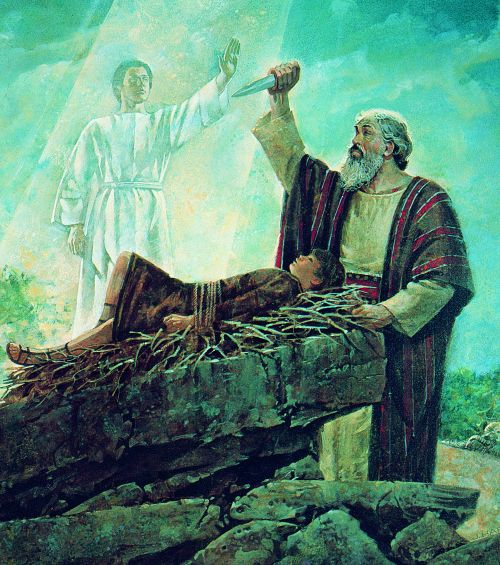
The image that comes to mind is of Abraham being willing to sacrifice Isaac, to kill his own son because God told him to. While this story is rich with spiritual significance, I must confess I find it hard to connect to this biblical story because of the extreme demands placed upon this sincere and trusting father.
The definition of sacrifice is "to surrender or give up, or permit injury or disadvantage to, for the sake of something else" (dictionary.com) which is the story of Abraham and Isaac in a nutshell - Abraham was willing to surrender and permit injury to his son for the sake of following the orders of God. Abraham passed the test of surrender and was allowed to sacrifice a lamb in Isaac's stead.
But the story haunts me.
Do I have that level of faith in God's instructions?
Uh, no.
Would I have faith in a God who demanded me to kill my son?
I don't know.
Which brings us back to the point that sacrifice is a loaded word - sacrifice seems to demand much from us, maybe even beyond our capabilities.
Which begs the question, then: Why on earth would anyone sacrifice anything at all?
Krishna says: To purify our hearts.
Certainly Abraham was put in the fire of faith, and he was forced to throw all of his doubts into that fire, and those doubts burned to ashes. He was purified and cleansed.
This verse from the Gita emphasizes that "sacrifice, charity, and penance" are essential to living a cultured, elevated life and should not be given up. These actions all emphasize one's willingness to surrender and give up one's time, money, energy, and being for the sake of something else. That "something else" in this case is to become pure.
Sacrifice, penance, and even purity are all rather abstract.
So Prabhupad gets concrete: marriage. He writes, "The marriage ceremony, for example, is considered to be one of these sacrifices. It is called vivāha-yajña." Marriage is a sacrifice - something that we surrender to, maybe even permit injury to ourselves or others (??) for the sake of something else. Maybe this is not us being willing to kill our own son for the sake of following God's orders, so what is that "something else" that we're surrendering to in marriage?
Why on earth does the institution of marriage even exist?
The most accurate available evidence suggests that the institution of marriage has been around for over 4,000 years (theweek.org). Marriage negotiations and ceremonies characterize ancient civilizations from all over the world. This shows that marriage is an integral aspect to human civilization, and we must conclude that it benefits human welfare.
Why? Well, the most logical response is that marriage has always been more of a business deal than a romantic fairy tale, benefitting (quite frankly) men. Women were bartered like property and dowry prices were negotiated like sacks of wheat. From a historical perspective, it seems that women got the bad end of the stick and were abused and treated like animals for millennia in archaic marriage systems.
But Krishna says here, 5,000 years ago, that "any sacrifice which is meant for human welfare should never be given up," and marriage is one of those sacrifices. Krishna is not only speaking on behalf of men who are doing all the bartering and arranging. Women are human beings also, and He is speaking on their behalf - marriage benefits women.
Marriage is a sacrifice, a surrender, a kind of austerity, or a "voluntary suffering" for both men AND women, and these kinds of activities generate power and cleanse the heart. Cleansing the human heart of lust, anger, and greed is meant for the true welfare and upliftment of society, not just economical advantages that can be gained and lost with a turning of the moon. True upliftment of society and human welfare means that the human mind and heart is cleansed and becomes peaceful. Prabhupad writes, "Vivāha-yajña, the marriage ceremony, is meant to regulate the human mind so that it may become peaceful for spiritual advancement." This is the goal of any sacrifice or austerity: spiritual advancement.
In modern times, marriage has become obsessively centered around "love." I must confess, I always wanted to marry someone I "loved" and I wanted to ensure we loved each other for our whole lives.
But the deeper significance to wanting to love and be loved within a marriage 'til death do we part is this even deeper desire and goal for divine, pure love - a loving, eternal relationship with God. This is a spiritual goal, something that cannot be experienced in a worldly relationship. But by being in a healthy marriage, we learn how to cleanse and purify our hearts, which makes us peaceful and open to spiritual advancement. That is the goal of marriage.
Full purport here: https://vedabase.io/en/library/bg/18/5/
First recorded marriage: https://theweek.com/articles/528746/origins-marriage#:~:text=The%20first%20recorded%20evidence%20of,Hebrews%2C%20Greeks%2C%20and%20Romans.
Friday, December 4, 2020
73: The Heat of Speaking (and not speaking!)
CHAPTER 17, TEXT 15: Austerity of speech consists in speaking words that are truthful, pleasing, beneficial, and not agitating to others, and also in regularly reciting Vedic literature.
"Austerity" is one of those arcane words that kind of has the average person going, "Huh?"
Either "austerity" is a foreign word or concept, or there are some vague connections to being rigid, extreme simplicity, or, as Oxford Languages puts it, "conditions characterized by severity, sternness, or asceticism." This last definition comes the closest to the original meaning of austerity.
But none of these point to why on earth anyone would undergo extreme simplicity, sternness or asceticism. No one in their right mind really wants to be an ascetic. In fact, austerity seems rather like self-harm (masochism)!
The Sanskrit word used in this verse is "tapa" which translates literally as "heat." This is because doing austerity generates a kind of heat, a personal power (or shakti) that ripples out into one's life.
This is the phenomenon of performing voluntary suffering - we are empowered to achieve a result.
In this way, most of us have all performed austerity for some reason or other - attending school and completing all that homework in order to receive a diploma, putting in overtime hours at a job to make extra money, working out at the gym in order to get a shapely body.
This is a law of the material world, just like the law of karma. Anyone who undergoes voluntary suffering generates power. This law can be applied in dark ways in order to gain power over others and to reach some exploitative goal, or this law can be applied in auspicious ways in order to be empowered to serve and love others with a clean and open heart.
For text 15 of chapter 17, we see that Krishna is describing austerity of speech in the mode of goodness. What's fascinating about the wording of this verse is that to be truthful, pleasing, and beneficial in one's speech is austerity - voluntary suffering.
How could be speaking in a truthful and pleasing way be voluntary suffering?
Because speaking in a deceitful and unpleasant and purposeless way is the default in this world. It's so easy.
Too easy.
To speak in a truthful, pleasing, and beneficial way takes hard work. It's depriving us of the delicious and easy tendency to gossip, complain, vent anger, blame, and criticize others. Prabhupad emphasizes that "One should not speak in such a way as to agitate the minds of others." But it's so easy to speak in such a way to agitate the minds of others! So easy!
Especially loved ones. We know their soft and vulnerable spots - with a well-aimed word we could incite agitation and pain in their minds and hearts. Just a word.
In this verse, Krishna does not give any advice about how to speak; He simply shares the nature of austerity of speech and what it looks like. In a way, He leaves it up to us to decide what we wish to create with our personal power.
To refrain from speaking words that agitates others is actually voluntary suffering and generates power.
By being austere in our speech, our hearts become powerful and strong, the heat of austerity coming back to nourish us and strengthen us to love and be loved at our highest potential.
Full purport here: https://vedabase.io/en/library/bg/17/15/
Saturday, November 14, 2020
55: Just Be Kind
CHAPTER 12, TEXT 15: He by whom no one is put into difficulty and who is not disturbed by anyone, who is equipoised in happiness and distress, fear and anxiety, is very dear to Me.
Brutal honesty is overrated.
I used to think that if I was in a close relationship with someone, that was a blank check to be "brutally honest" because, hey, honesty is the foundation for true friendship and love. I allowed others to be honest with me to the point of pain because I thought that that was healthy.
And to a certain degree, it can be.
The problem with brutal honesty is that without the skills or a deep enough relationship, it just often ends up being brutal. All that truth hurts and drives splinters and knives into a relationship. I speak from experience when I say that the relationship does not recover.
This "brutal honesty" towards our loved ones is one way that we can put others into difficulty and disturb their hearts and minds. Personally, I have rarely ever felt moved to deeper understanding and personal growth from someone being brutally honest with me, even if that person was a very intimate friend or family member.
I just feel hurt.
I am most moved when someone is kind to me.
In this verse of the Gita, Krishna emphasizes a kind of deep equanimity and peacefulness that should permeate our lives. The first phrase, "He by whom no one is put into difficulty," is poignant for this post. Not putting others into difficulty often boils down to a simple quality to exemplify at all times to all people: kindness.
So much is included in the quality of kindness: respect, care, attention, empathy, gentleness, and even love. Prabhupad writes, "Since a devotee is kind to everyone, he does not act in such a way as to put others into anxiety." This means that the default should be kindness - respect, care, and empathy - for everyone at all times.
Chaitanya Mahaprabhu emphasizes in the Siksastakam Prayers, Verse 3 "amanina manadena" - one should offer all respect unto others and expect none in return. Kindness and respect is not superficial, a mask to put on to people-please. In fact, to offer respect and kindness towards others at all times requires a deep expression of the soul, and this sincere striving to cultivate one's highest qualities is very pleasing to Krishna - He states in this verse that such a person is "very dear to Me."
I think of my husband in this regard. He is kind and respectful to everyone at all times, including me, and we have been in a relationship for seven years. Even though we are close, he never takes advantage of this closeness to be "brutally honest."
He is honest AND kind - he does not put me into difficulty. By his unconditional kindness he moves me to be the best person I can be every day. Surely he is dear to Krishna.
He inspires me to be dear to Krishna, too. That starts with being kind to all.
Full purport here: https://vedabase.io/en/library/bg/12/15/
Saturday, April 11, 2020
Day 31: A Really Good Question
Arjuna has received instructions about the nature of the soul and the supreme value of pursuing the spiritual path. These instructions are so logical and make so much sense, it's difficult to deny that the ultimate goal of human life is to set one's mind on Krishna and offer one's very self in devotional service.
But Arjuna has a doubt.
This goal is so high - love of God - that it seems unattainable.
So Arjuna is wondering - on behalf of all of us - if I fall from the spiritual path, where will I fall?
What's more, if one is on the spiritual path, then maybe material life is neglected. So not only would someone fail at spiritual life, s/he would fail at material life too. Double whammy! Prabhupad writes: "If the aspiring transcendentalist fails, then he apparently loses both ways; in other words, he can enjoy neither material happiness nor spiritual success." This is a lose-lose situation, and it's a possibility for each and every one of us:
Failure.
No progress, no success, no belonging, just...
You failed.
Prabhupad defines the term "riven cloud": "A cloud in the sky sometimes deviates from a small cloud and joins a big one. But if it cannot join a big one, then it is blown away by the wind and becomes a nonentity in the vast sky." Note that the cloud may start off in a smaller cloud - this represents being in the material world, with relatively small goals and small aspirations. When a cloud breaks off to join a bigger cloud, this represents the soul's desire to achieve something much grander than itself. But when the cloud fails to belong in that spiritual place - the soul is "bewildered on the path of transcendence" - then it wanders and dissolves into nothingness. It belongs neither here nor there - it is "riven."
Arjuna's fears strike a deep chord. Not only do humans want to succeed in an endeavor, they also need to belong. Karyn Hall, Ph.D. writes in her article "Create a Sense of Belonging" in Psychology Today, "A sense of belonging is a human need, just like the need for food and shelter." The possibility that one may not belong anywhere and simply dissolve into a "nonentity" is a frightening prospect indeed. We're hardwired to be connected to something bigger than ourselves. But the problem is that we could fail to belong, and we could fail to succeed in life.
In his question, Arjuna is expressing some of our deepest fears: failure and belonging nowhere.
Don't you notice that when a question is good, like, really good, we want to know the answer? Well, now we're set up. We want to know.
So let's lean in and hear what Krishna has to say.
Full Purport by Bhaktivedanta Swami Prabhupad here: https://vedabase.io/en/library/bg/6/38/
Hall, Karyn. “Create a Sense of Belonging.” Psychology Today, Sussex Publishers, 24 Mar. 2014, www.psychologytoday.com/us/blog/pieces-mind/201403/create-sense-belonging.
Tuesday, March 24, 2020
22: Open Heart Surgery
My husband works at a hospital as a chaplain, or a spiritual caregiver; the other day, he mentioned how one of the patients he has been visiting for a year and a half, Paul (pseudonym), received news that he will be receiving a heart transplant. Finally.
Paul was on the road to death but is now being given the opportunity to leave the hospital to continue living his life as a wonderful husband and father of two boys.
When I heard this, several thoughts passed through my mind: 1) someone had just died unexpectedly - someone young - who had been willing to donate their organs, 2) that person's heart was going to be cut out of his/her chest, 3) Paul's current heart was going to be cut out of his chest, 4) the other person's heart was going to be placed in Paul's chest. This sounds rather gory and graphic, but really, think about it. An old heart for a new heart.
And then my mind went to 5) who is the person who would complete this surgery?
???
A heart transplant surgery seems to be the equivalent of a modern miracle, and I have not the slightest idea how one would even begin to go about such a task. What I know for sure, though, is that the surgeon who will perform this "miracle" has studied for years and years and years and has practiced medicine in a residency with other advanced surgeons for years and years and years.
Similarly, spiritual life is a complex science that requires daily, challenging application.
How does one respond to the sudden loss of a loved one?
How does one respond to betrayal?
Humiliation?
Failure?
How does one respond to crisis? Hardship? Suffering?
Being able to respond with integrity in each of these situations is as complex and intense as conducting heart surgery. If mastery of a material science, such as medicine, requires years and years of study and supervised practice, why would mastery of spiritual life be any different?
Srila Prabhupad writes in his purport to this verse that mental speculation, dry arguments, independent study of books of knowledge, and/or manufacturing one's own process do not lead to spiritual realization or progress. Imagine if a surgeon simply studied books of medicine, or theorized about the function of the heart, or maybe even invented his own heart surgery transplant procedure - this would be ludicrous! Dangerous! Similarly, spiritual life is meant to be be studied and practiced under the supervision of those who know much more than we do. Spiritual life is meant to come from an authorized source with an authorized practice.
Deciding to approach a teacher for guidance is a great hallmark of material AND spiritual progress, and the mood to do so is laid out here: 1) inquire submissively, and 2) render service.
Inquiry does not always mean asking questions - true inquiry means to be vulnerable and to open the heart to truth.
Rendering service to a teacher demonstrates that "yes, I am ready to receive the truth from you and put these principles into practice." Service shows sincerity.
With these two elements, submissive inquiry and sincere service, the teacher is satisfied, and when a teacher is satisfied, blessings flow. Sometimes I wonder how certain people can go through life with such resilience, blossoming and glowing with growth on the spiritual path even when faced with so many hardships. Prabhupad writes, "Satisfaction of the self-realized spiritual master is the secret of advancement in spiritual life." So, this is their secret: satisfying the spiritual teacher through inquiry and service. In fact, "Unless there is submission and service, inquiries from the learned spiritual master will not be effective." This shows that the student must be responsible for preparing his or her heart to receive the truth, like having fertile ground for the seed of devotion to unfurl.
That said, inquiry should not be combative or forceful or speculative, and service should not be rendered to just anyone. This makes the soil of the heart rocky, dry, and acidic. Inquiry needs to be humble and thoughtful, and service rendered should be carefully done within one's means. Prabhupad writes, "In this verse, both blind following and absurd inquiries are condemned." Striking this sincere and mature balance of inquiry and service is all a part of our own "spiritual residency."
Ultimately, you could say that the spiritual path is about replacing our old and diseased and failing material heart with a fresh and healthy and vibrant spiritual heart. We are in the process of our own heart surgery - and we are the surgeons. This is what's at stake - our hearts. Our lives.
In order to undergo such a precarious transformation, we need to take shelter of knowledge that is far beyond our own understanding. We need to be guided by those whose hands are much more capable and experienced than ours.
And when the hardships come, because they will come, we can respond with that spiritual heart, the glowing, vibrant heart that is resilient beyond anything in this world.
Full purport by A.C. Bhaktivedanta Swami Prabhupad for Chapter 4, Verse 34 here: https://vedabase.io/en/library/bg/4/34/